
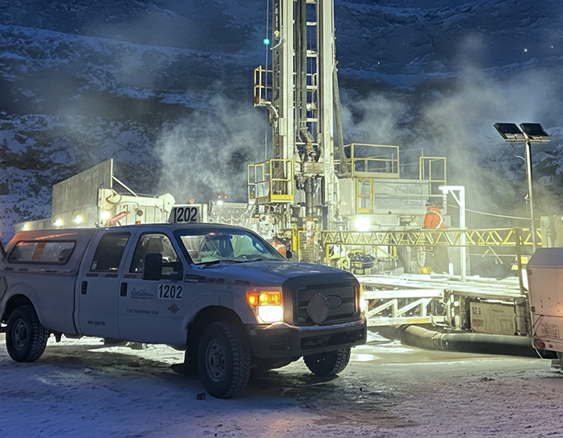
By collecting continuous subsurface measurements inside boreholes, logging provides engineers and geologists with critical information needed to design safer mines.
Why Mine Safety in Underground Mining Depends on Accurate Data
Mine safety in underground mining is directly tied to how well operators understand the rock mass before development begins.
Common underground hazards include:
- Fault zones and shear structures
- Weak or fractured rock
- Sudden lithological transitions
- Unexpected water-bearing formations
- Structural complexity affecting excavation stability
Traditional drilling and core analysis provide valuable information, but core samples alone cannot deliver a complete picture of the formation.
This is where downhole geophysical logging becomes essential.
Logging tools measure physical properties continuously throughout the borehole, filling the gaps between core samples and improving geological interpretation.
How Downhole Geophysical Logging Improves Mine Safety
Downhole logging contributes to mine safety in underground mining by helping engineers and geologists identify potential hazards earlier in the planning process.
Improved Ground Control Planning
Ground control decisions depend heavily on rock competency data.
Logging tools such as density and acoustic instruments help identify:
- Weak rock zones
- Fractured intervals
- Structural disruptions
With better subsurface information, engineers can design more effective reinforcement systems and avoid unstable ground conditions.
Structural Identification and Fault Detection
Faults and structural features are common contributors to underground instability.
Deviation surveys and structural logging tools provide data that helps geologists:
- Identify faults and shear zones
- Confirm borehole trajectory
- Improve structural interpretation
Accurate structural information allows mine planners to adjust development headings before encountering hazardous conditions.
Reduced Worker Exposure to Unknown Conditions
Accurate data allows operators to make informed decisions before crews enter underground environments.
Better geological information leads to:
- fewer exploratory headings
- improved development planning
- reduced exposure to unknown hazards
Reducing uncertainty directly improves mine safety in underground mining operations.
Borehole Conditions and Logging Accuracy
The reliability of geophysical logging depends on understanding borehole conditions.
Factors affecting logging quality include:
- borehole diameter changes
- tool standoff
- washouts or rugosity
- fluid conditions within the hole
Experienced logging crews apply environmental corrections to ensure measurements remain accurate despite these challenges.
Proper calibration and quality control ensure the data can be used confidently for engineering decisions.
The Role of Calibration in Reliable Logging Data
Calibration is a critical part of producing defensible geophysical data.
Before logging operations begin, tools must be verified against known standards to confirm they are operating correctly.
Typical quality control procedures include:
- calibration block verification
- repeat logging sections
- post-run instrument checks
- depth correlation validation
Without proper calibration, logging measurements can drift, reducing data reliability and potentially impacting mine safety decisions.
Integrating Logging Data with Core and Geological Models
Geophysical logging does not replace core sampling. Instead, it strengthens geological interpretation by providing continuous measurements.
When properly integrated with core and laboratory data, logging helps:
- refine geological boundaries
- improve structural models
- validate density measurements
- Identify inconsistencies in core recovery
The combination of core analysis and logging data significantly improves confidence in mine planning.
The Broader Impact of Mine Safety in Underground Mining
Improving mine safety has benefits beyond protecting workers.
Better geological understanding leads to:
- fewer unexpected development issues
- improved engineering efficiency
- Reduced project delays
- stronger regulatory compliance
Operators that invest in accurate subsurface data often experience safer and more predictable operations.
Frequently Asked Questions
How does geophysical logging support mine safety?
Geophysical logging provides continuous measurements of rock properties inside boreholes, helping identify structural hazards and unstable ground conditions before development begins.
Is logging used in active mines?
Yes. Logging is commonly used in both exploration drilling and operational mines to improve geological interpretation and reduce risk.
What types of logging tools are used in mining?
Common tools include natural gamma, density, resistivity, acoustic imaging, and borehole deviation surveys.
Does logging replace drilling core analysis?
No. Logging complements core data by filling gaps between physical samples and improving geological models.
Conclusion
Mine safety in underground mining begins with understanding the ground before excavation starts.
Downhole geophysical logging provides the data needed to reduce geological uncertainty, identify hazards early, and support safer development planning.
With accurate subsurface measurements, operators can make better decisions, reduce risk, and create safer working environments underground.